

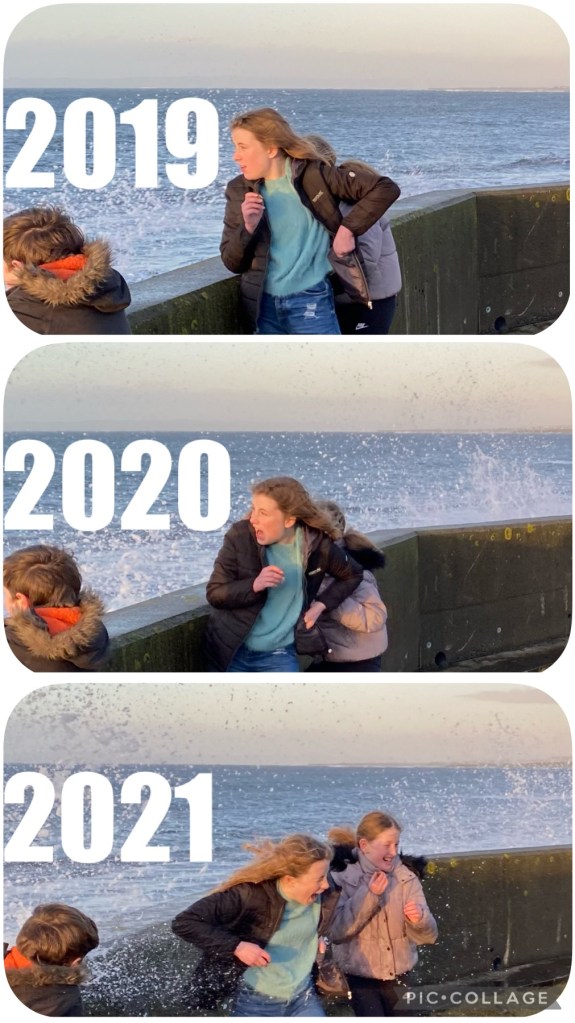
Friday, Jan 7th and the call comes- I’m COVID-negative and the team has been assembled. The hyperbaric oxygen therapy (HBOT) session will start at 3:30. The trip to Galway is preceded by brief walks with the kids on a variety of beaches to see the winter waves emulating what was going on in the world generally and my microcosm specifically.
On arrival, I go through the admissions process with a kind lady who is keen to get me on my way into the treatment chamber. She is distraught at calling out my late mother as next of kin. This was the case when I was a small child attending this hospital. I tell her about the fantastic care that she received from her colleagues and the NOK is updated.
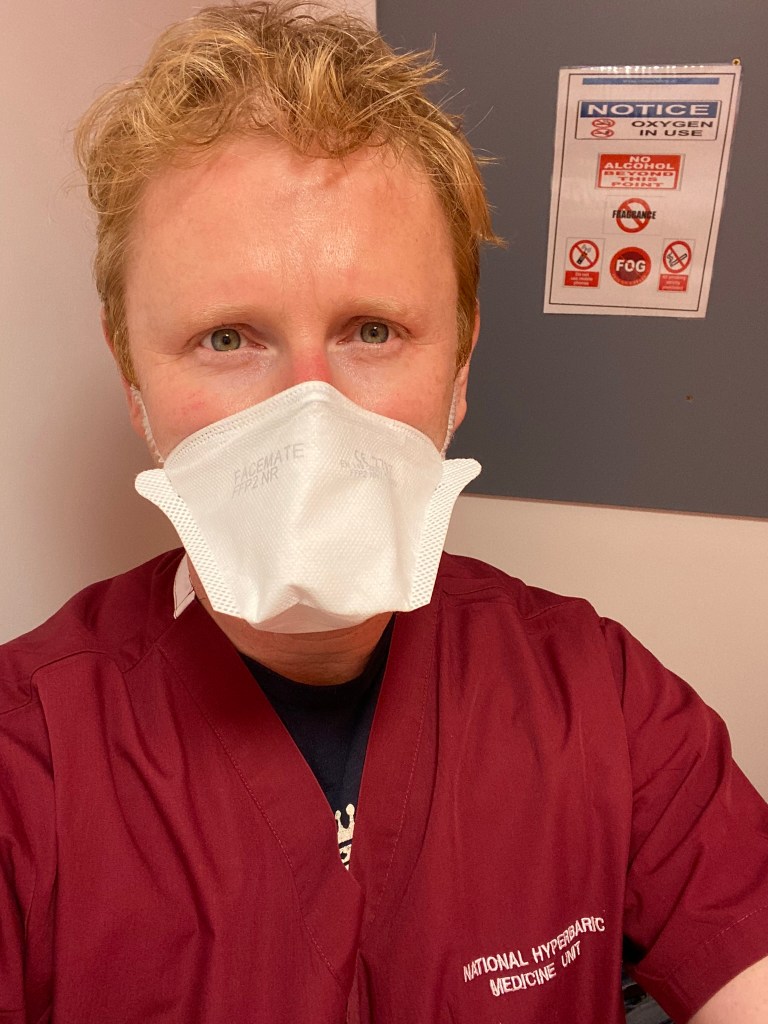
The critical care nurse, who also works in the Hyperbaric Medicine Unit, will be my guide and companion for the next three hours or so. He orients me to the unit and gives me a locker and scrubs. Nothing comes into the unit except a book which is unnecessary as we talk all the way through the 2-hours in the tank.
The unit director is the next person that I meet. She is an anaesthetist and intensivist who runs the unit with a multidisciplinary team of colleagues and volunteers. She got her introduction to it through her own interest in diving. Our conversation touches on the health system and the challenges of the past two years. Some of the staff on the unit are also working in ICU as they need to be able to provide ICU-level care for seriously injured divers. She talks me through the potential benefits and risks, how we will assess response and sets expectations. Including the possibility that my hearing returns only to go again. We are on the same page.
Here are some overviews of the anatomy of the outer, middle and inner ear and the physiology of hearing. Essentially we’re trying to flood the inner ear tissues with oxygen in the hope of reversing the damage to the hair cells that are essential for hearing. My hair cells are currently dead or dying. I’m getting my first hyperbaric session on day 13. I’m aware that there’s some evidence to suggest that this might help me and that clinical guidelines recommend it, although an earlier Cochrane review did not find sufficient evidence to support its use.
The Clinical Engineers/volunteers are ready for us to enter the chamber at this stage. It is a multi-person chamber that accommodates 12-14 people or an entire intensive care set-up around a single patient. The pressure is increased gradually until we’re at the equivalent of 14 meters of water. The nurse takes me through the process of swallowing to equalise air pressure every 15-30 seconds. We’re both wearing breathing masks throughout this process. We talked all the way through the sessions- we have similar jobs and roles in healthcare IT, families, and experiences growing up. All that was missing was a couple of pints and some cheese and onion Tayto.
The Oxygen is turned on once the chamber is pressurised. We cycle through 30-minute sessions of 100% oxygen followed by a break to air for 5 minutes and then back on 100% oxygen. About halfway through the session the inspiration sound became perceptible in my left ear- Was this real or imagined? Over subsequent sessions, I see that it’s related to the close proximity of the oxygen tube to my ear, combined with the high pitch of oxygen rattling through the tube. Pressing on my ear also yielded more reaction (volume and frequency range) than it had over the past couple of weeks.
We talk after the session and the subtle changes are encouraging. I will need an objective test of my hearing to determine if it is worthwhile continuing with treatment. There’s some cautious optimism, but this is no miracle cure for me. Listening to Here Comes the Sun on headphones showed that the left ear is not picking up sound as usual, but there is definitely more there than before the first session. We make arrangements for the coming days. We are still on a few days off from work, but I have to arrange sick leave to enable continued access to this treatment. My wife will go back to work and get the kids to school. I’ll stay over this side of the country to complete the course.
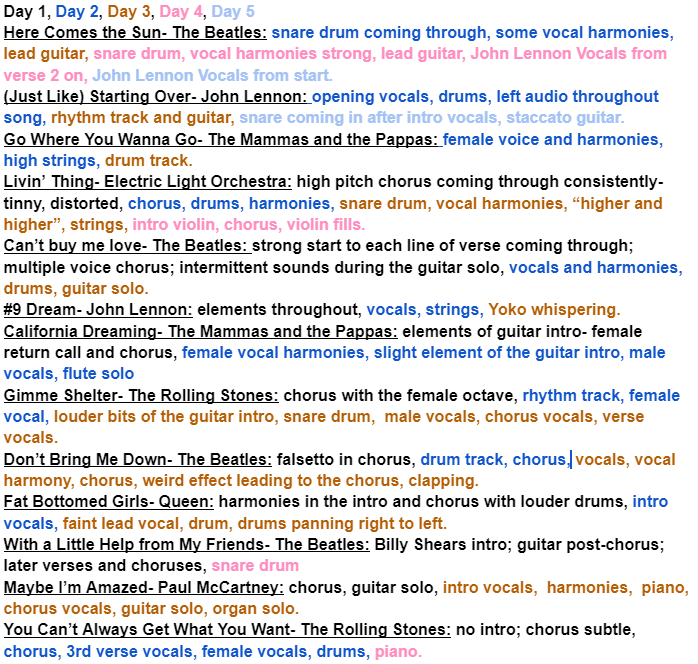
A bus passes as I walk out and I can hear the sound of the wet street under the wheels. I call my wife and her voice is sending distorted tinniness through the headphones to my left ear. Previously, only the children’s louder screeches did this. I put on Here Comes the Sun as I’m leaving Galway in the car. It will help give me a sense of any changes if I listen to the same songs after each session. A playlist automatically generates and I listen to this playlist each day, noting any changes. It’s the best I can do in advance of a proper repeat audiogram in a few days.
Now, when I say that I can hear these parts of the songs- it is a distorted awareness of that part of the song rather than crystal clear hearing. The colour-coded section below records what I heard when over the first few days. The first thing that I heard on day one was the chorus of Livin’ Thing by ELO. There were tears.
Day 7 of HBOT. I’m sitting in the soundproof room again for one of the most important tests in a long time, meaning more than the entrance exam, the Junior or Leaving Cert, the Driving Test, finals, and registration exams. All the old familiar tense anticipation and butterflies. Then tears of relief, joy, what else? There are subtle improvements. I’ve moved from well within profound loss to the border between profound and severe loss. I would still describe the extent of my left ear hearing as a gritty fuck all, but there is something going in. It’s a distorted sizzle of sound, but it’s sound and I can work with that. This may not be fixable. If it is to improve it will be measured over months not days, so I’ll soldier on and lay the best foundation I can for the recovery process.
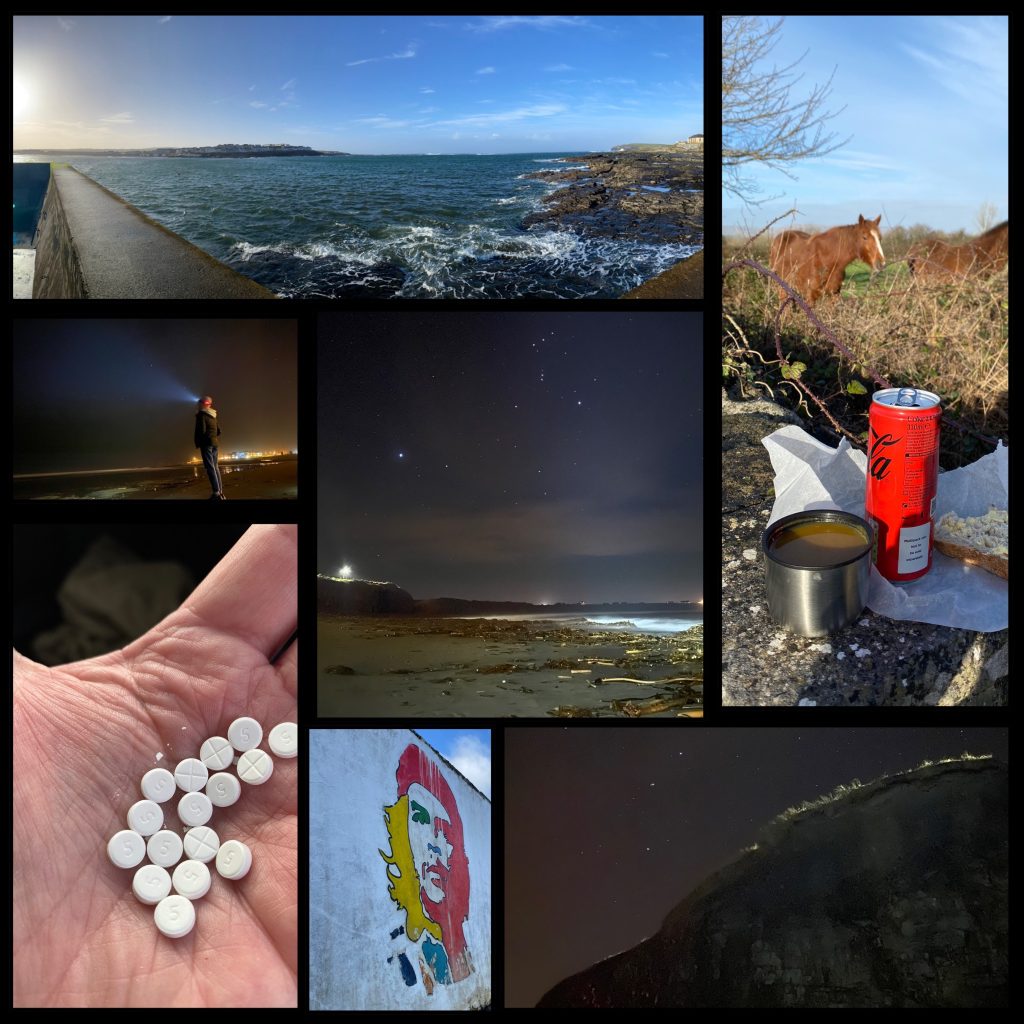
My treatment course complete in Galway, I pack up the car and race back to see my family. I’ve spent a chunk of time on my own so that I can access treatment and avoid COVID. I’m glad to be heading back to civilisation. I’ve walked the beaches of west Clare morning, noon and night for the past few weeks. Solvitur ambulando. Audiobooks have been great companions with the frustrations of fluctuating sound levels as the actor cycled from shouting to a whisper for dramatic effect limiting what I can hear. There are lots of photographs.
I’ve had 10 sessions in Galway to some effect and need to access more to meet the level of treatment recommended in clinical guidelines. I’m assessed at a Dublin hyperbaric unit. This is a private clinic that accepts referrals from hospitals for medically indicated HBOT. They’ve been recently accredited by a respected international healthcare standards agency and insurers are paying for treatment courses for an evidence-based list of indications. There’s a genuinely warm welcome and I can see that the staff are enthused that their efforts have saved limbs, hearing and relieved devastating side effects of cancer treatments. I sit in the chamber again, this time in a buzz lightyear oxygen hood- these will be group sessions and in order to avoid transmission of COVID, all patients must wear these hoods. Again I’m in the therapist’s chair. The nursing staff in these units are deft conversationalists. I’m convinced that this generates some of the therapeutic effect.
Three weeks into the process and I’m cancelling work commitments for the week and watching an introduction to lip reading on YouTube before going in for a hyperbaric session. It’s a new world of shapes, signals and cues where context is king. A new vocabulary for me- diphthongs, monophthongs, phonemes. I’m going to get a crash course in the anatomy of language starting with the basics: Mama, Papa, Baby. I’m mouthing these words and feel some possibilities opening up. Some of the anxiety of exclusion and social limitations begin to melt. There’s genuine surprise that I’m getting words like Arizona and random numbers out of order like 47, 45, 41. This is a mindful act. There is no multitasking, no glances at the phone. It is absorbing and rewarding. The only problem with lip reading is that masks will continue to be part of my working world for a long time to come and there’s the general reluctance to have cameras on for video calls, so my lip reading practice remains limited.
My hearing loss has resulted in tinnitus and hyperacusis. I’m acutely sensitive to sound. The TV volume needs to be super low and I need subtitles not to miss things. By the end of the day my head is splitting with loud tinnitus. Some days have dark tinges. I reach out to a charity that supports patients with hearing loss, but find it is very technology focused. I continue the lip reading lessons. I make an appointment with occupational health. We’re currently just past the peak of the omicron wave and it’s a worry to maintain access to treatment when COVID is everywhere and everyone in this house needs to get out there and live. Dealing with the situation is taking centre stage and I need to work towards making it a background thing.
I hear Austin O Carroll on the promo for the Brendan O’ Connor show. Austin is a colleague and thalidomide survivor. When asked for advice on how to support a teenager struggling with disability- his direction is to “get out there and live”. I’ll be finished the hyperbaric sessions soon. I read articles to prepare for the return to work. Read this one for yourself. It is technical in parts but it matches my experience which has taught me that the impact is profound and far beyond what I would have anticipated before I woke up and found myself in this situation.
Single-sided deafness refers to unilateral hearing loss in the severe to profound territory with very poor word recognition ability. Typically the level of hearing loss is beyond help from hearing aids. You need to have some hearing to be able to aid it. A fellow soldier in the hearing loss wars has a great blog that outlines their experiences. It includes a section on interpreting audiograms and degrees of hearing loss.
Single-sided deafness can turn you into a prick: “The behavioural manifestation of this deficit presents as distracted, aloof or inattentive.” An (incomplete) list of potential effects of hearing loss include cognicognitive decline, cardiovascular disease, depression, sleep disorders and social isolation. Hearing loss is expensive for the individual and society in terms of lost productivity and higher rates of unemployment. The article above cites an incidence of 12-27 per 1,000,000 annually. For Ireland, this translates to about 100 people a year from a variety of causes. Sudden onset single-sided deafness is acknowledged medically as extremely debilitating, but misperceptions persist that one normal hearing ear is fine for daily communication needs. Advocacy is badly needed to raise awareness of this mostly invisible disability and to ensure rapid treatment to avert long-term irreversible damage.
I enjoy the pause. My job now is to give myself the best possible chance of recovery. I eat at Shouk in Drumcondra on a Wednesday. What is usually the preserve of a Friday evening, the bulk of the week’s work done, now takes up a chunk of Wednesday afternoon. I listen to and absorb James Joyce’s Ulysses into my pores. I scan 60 years’ worth of photographs. I walk and walk and walk. With the dog, with my kids, with my wife. I live more completely than I have in a long time.
The audiology tests get copied and pasted into PowerPoint. I align them and make them the exact same size. Flicking through them you can see how the line changes through successive hearing tests. There is very little change in the later tests. This is disheartening and depressing.
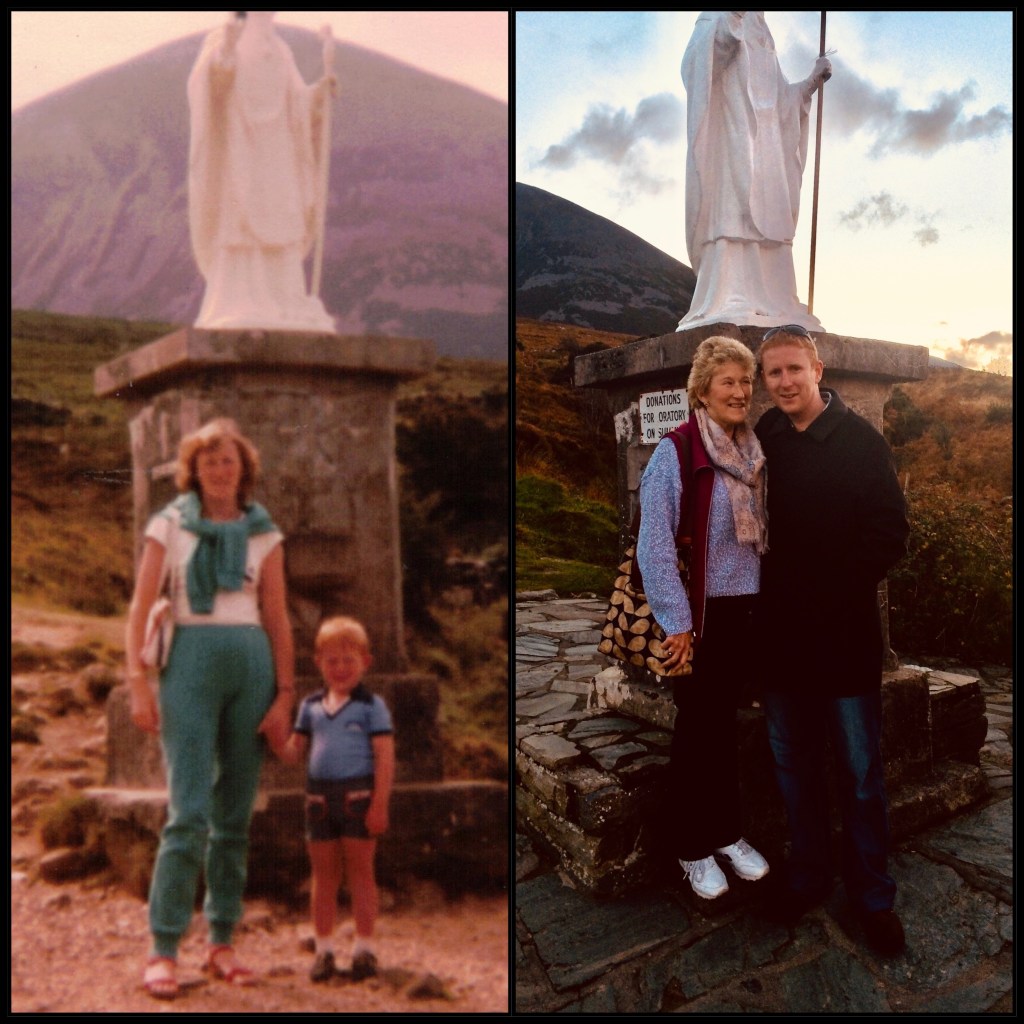
This could be it. Am I flogging a dead horse? I miss my hearing. In the massive scanning project, I come across a photo from when I was four. I stand with my mother at the foot of Croagh Patrick. We went there a few weeks before she died. The last day out. We took a photo that day too. I line them up like the audiograms. The exact same position. Me on her left. I miss her too. She would have been a major advocate through this whole process.
Queen’s Under Pressure comes on the radio again. My third time hearing it in my 20 sessions with the superstars in Oxycare. I’m not sure if it’s always on the playlist for this station or if it’s a sign. Joni Mitchell‘s Big Yellow Taxi also features repeatedly- “Don’t it always seem to go that you don’t know what you’ve got till it’s gone.” The technician’s voice comes through the chamber’s speaker: “Oxygen; last session” – with as much positivity and optimism as you can squeeze into those six syllables. This is the last cycle of 100% oxygen of this last session in the hyperbaric chamber for me. There is a sense of relief to get to the end of this treatment cycle, with some trepidation for what comes next. I’m delighted that I was able to access this treatment. I gave it my best shot. I achieved subtle improvements in hearing, but I still have significant hearing loss. I’ll never know the outcome had I been treated sooner. Time will tell what the ultimate result is.
Outside in the car, as I write this there is a mix of spring birdsong. “Teacher, teacher, teacher, teacher” and other cheerful chirping that I can’t locate due to my single-sided hearing. As I pull out of the car park Here Comes the Sun comes on the radio.
 noisy silence