
With the hyperbaric treatment complete it’s time to get back to work and experience the impact of my hearing loss beyond home and family. I have to meet with occupational health for an assessment before I start back. There’s an initial fact-finding call with the doctor. He reassures me that it’s going to be ok and that lots of people excel at a wide variety of jobs with hearing loss. He refers me to a local audiologist for a back to work audiogram.
In advance of those appointments, which land the day before I’m due back, I engage with the employee assistance programme (EAP). It’s very unlikely that I’ll recover any further hearing and I want to preempt the potential mental health consequences of the trauma of sudden permanent hearing loss and the ever-present tinnitus. I’m aware of the major impact on quality of life of sudden hearing loss. I’ve also seen studies associating hearing loss with cognitive impairment, depression, anxiety disorders and psychoses. I’ve come across reports of tragic cases of people who couldn’t escape the suffering of severe or catastrophic tinnitus. There are also reports that assess how illness experience varies and how coping strategies can impact on that illness experience. I use the EAP to book 8 counseling sessions in a local therapy center. Although I did not have suicidal thoughts or suicidal ideation I was very aware that this was a possibility. I was also conscious of the important work of organisations like Pieta House and Suicide or Survive and people like June Curtin of Snámhaí Sásta. I’ll do whatever is needed to ensure that the cruel and never-ending ramifications of suicide will not darken my family’s door.
If you come across reports of suicide in the context of tinnitus, remember:
- Suicide is an important public health issue and research in this setting is not clear on the relationship between tinnitus and suicidal ideation/suicide- both of which are hard to measure accurately in order to do population-based studies.
- Hearing loss is a solvable problem with lots of stories of adjustment, recovery, hope and healing.
- Seek professional help and preempt problems if possible- find positive coping skills. This might be an opportunity to find a new balance and give yourself the tools to recover.
- Resources and supports are available to help with both tinnitus and suicidal thoughts/ideation. Look for local crisis supports e.g. those available in Ireland, the UK and the US.
The counselor was fantastic. She commends the proactive approach to mental health and every monday evening there’s structured support and lots of listening. We talk about a variety of issues- other’s understanding of the condition, the effect of reliving the story repeatedly, how to approach the return to work, how to get through this transitional period without becoming sad dad/cranky dad and how to create time and space to deal with this situation. My key message for people in a similar situation (if anyone has read this far) is to seek help and give yourself time and space to adapt. Don’t bottle up and ignore feelings or symptoms and be vigilant for the development of mood changes. I had a few years of experience with mindfulness before my hearing loss, but it was not really a runner for me at that time. As a former boxer said- everyone has a plan till they get punched in the face. Sometimes you need external help.
A work colleague with hearing loss suggests meeting for lunch before I go back. One impact of the process of telling the story via twitter (here and here) is that I get in touch with a range of people with experience of hearing loss, particularly in my professional networks. We compare notes and what we’ve been told to date and potential approaches. I start to envisage how my job will be feasible with some adjustments.
The audiologist appointment arrives and I go with a list of questions. We’ve talked beforehand and she is incredibly supportive and positive and I’m looking forward to the appointment, anticipating leaving with a hearing aid. She’s reassuring and knowledgeable. There’s another audiogram with very little improvement. She encourages me to get as much stimulation as possible for the affected ear; keeping the auditory pathway stimulated may increase options in the future. I get a mould of my ear made so that she can order a custom silicone ear plug that my future hearing aid will connect to.
We talk about word recognition/testing – not an issue for me as I’m clearly at 0%; sound therapy/auditory rehab; potential assistive devices for work- I can’t stream to my hearing aid as I’ve no functional hearing in that ear; dealing with noisy environments; strategies for dealing with tinnitus; concerns about contralateral routing of sound (CROS) hearing aids and noise sensitivity/hyperacusis/impairment of my good ear; the effectiveness of bone conduction hearing aids; and, most importantly, ways to access a cochlear implant.

I get my hearing aid a few days later, bypassing middle age and going straight to Werther’s Originals and the Men’s Shed. No one should make light of hearing loss, but I did have a sense that hearing aids were more of an issue for people my Dad’s age rather than me- I was 41 when this happened and most of what I came across in relation to hearing aids was targeted at people 30 years older than me. The hearing aid is tiny and I wear it all the time. I don’t recognise any words, but louder sounds register as a distorted sizzle and my auditory nerve is being stimulated again.
There’s a hunt for information from people who are ahead of me on their SSNHL process. One terrible side-effect of my hearing loss is the need to finally succumb to Facebook. There are a few great resources that I find online or via Twitter. One focuses on sudden hearing loss another on cochlear implants for single-sided deafness. There’s even one that focuses on health professionals with hearing loss- the Association of Medical Professionals with Hearing Loss. Carly Sygrove has a blog that documents her experience of SSNHL and a website for sudden hearing loss support. I’m writing this long form content to satiate the need for details that some people have. Sometimes there were limited details on the forums and this is a quest to provide the details (sorry!). I hope that this effort might get information to people in my specific situation and help them head in the direction that is right for them.
There’s some bullshit on the forums with dodgy accounts actively promoting quackery. The majority of forum members are intolerant of these scams and they’re quickly reported. Despite that it’s still useful to get nuggets of helpful information like the utility of Apple AirPods, weaning off ear protection/dealing with hyperacusis, approaches to getting a cochlear implant and international approaches to SSD including entry criteria for cochlear implant surgery and rehab.
A post discusses a Japanese research group who studied the impact of constraint induced sound therapy on SSNHL outcomes. This entails 6 hours of music daily in the affected ear. Headphones on. Good ear blocked up with silicone earplugs. iPhone directing all the sound to the left ear. I don’t think this is an evidence based treatment yet, but following discussion with the audiologist, it’s unlikely that getting as much sound enrichment as possible into the affected ear will cause any harm. It’s a job I can take on, but I’m very conscious that I’m most likely flogging a dead horse. In the initial consultations early in this process I asked one of the ENT consultants in Galway what would get me the best possible hearing if the hearing loss was permanent, asking about the various surgical options including bone conduction hearing aids. His response- if you are going to have surgery, get a cochlear implant. With this in mind, I do everything I can to stimulate the remaining hearing and the auditory pathway, building the right foundations for a future CI.
Returning to work is a return to lots of supportive colleagues but it also unmasks many of the effects of single sided deafness. At its simplest I can’t eat in the main canteen anymore. The building is from the 18th century and the vaulted ceilings of the cellar canteen produce a reverberant effect that drives the tinnitus bananas and means that I have very little word recognition. There’s a side room with low ceiling tiles that works a bit better. The spontaneous lunches with various people who work in the hospital won’t happen now, but that’s just one of the adjustments. The reactiveness of my tinnitus is probably my biggest problem.
Loss of binaural summation means that I need to get the right physical location relative to the people in a conversation and background noises in order to hear properly. There is definitely an increase in the cognitive load to select out what you need to hear from all of the background environmental noises of the workplace. I get into the best possible positions in the various listening scenarios that my work demands and constantly move my head to get the best signal to noise ratio.
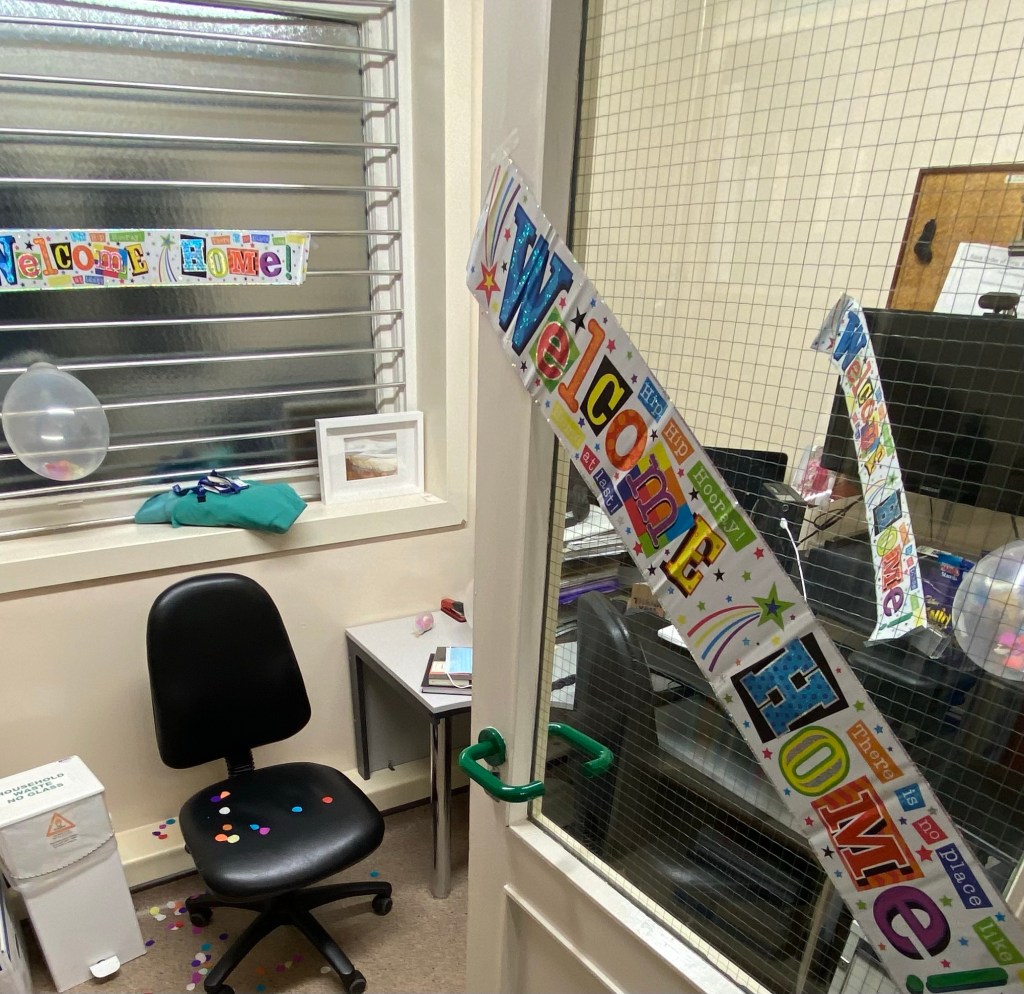
My biggest listening challenge that I’ve been concerned about right from day one is a multidisciplinary ward round in a busy, noisy ICU environment. This was the first thing on the agenda on day one. First though, there’s an incredibly warm welcome back from my colleagues- balloons, bunting and confetti- and I fill them in on the story so far beyond what I’ve shared on Twitter and in WhatsApp groups. They’re super supportive and it’s genuinely great to be back. The fear begins to melt.
I go to the ward round shadowing a colleague until I’ve a better sense of my abilities and limitations. Unfortunately the welcome party has made us late and I’m away from the centre of the ward round and struggle to hear. The rest of the day is fine and the frequent Zoom/Teams calls allow me to control the volume and use closed captions. I’m essentially trying to operate at the lowest possible volume to avoid exacerbating the tinnitus. I’m able to practice my lip reading when people share their video. At home time, there’s a sense of relief that this is tough, but feasible. After the day of stimulation, it’s nice to put on noise cancelling headphones for the walk home.
On day two I go back to the ward round and have time to talk to the consultant before we start. She is incredibly supportive. Before my return to work, partially to spare me retelling the story a lot, I let people know about my hearing loss via a departmental WhatsApp group. Although it’s a mostly invisible disability, you would be fooling yourself trying to conceal it. There’s no benefit to suffering in (noisy) silence. A more in depth conversation with people on the ground enables practical changes e.g.
- Allowing me to position myself optimally
- Speaking loudly and clearly – lots of people who are also struggling to hear thank me for this one
- The speaker who is presenting a patient should face the multidisciplinary team, not speak into space or the computer monitor
- Actively managing overall noise levels in the department e.g. background conversations, alarms ringing for excessive lengths of time
The round is run in a way that accommodates my hearing without impairing the work that we need to do. As a result, I can consistently get into a position where I have no problem hearing what is going on. This was one of the toughest listening scenarios that I could envisage and I left the ICU with an immense sense of gratitude and relief.
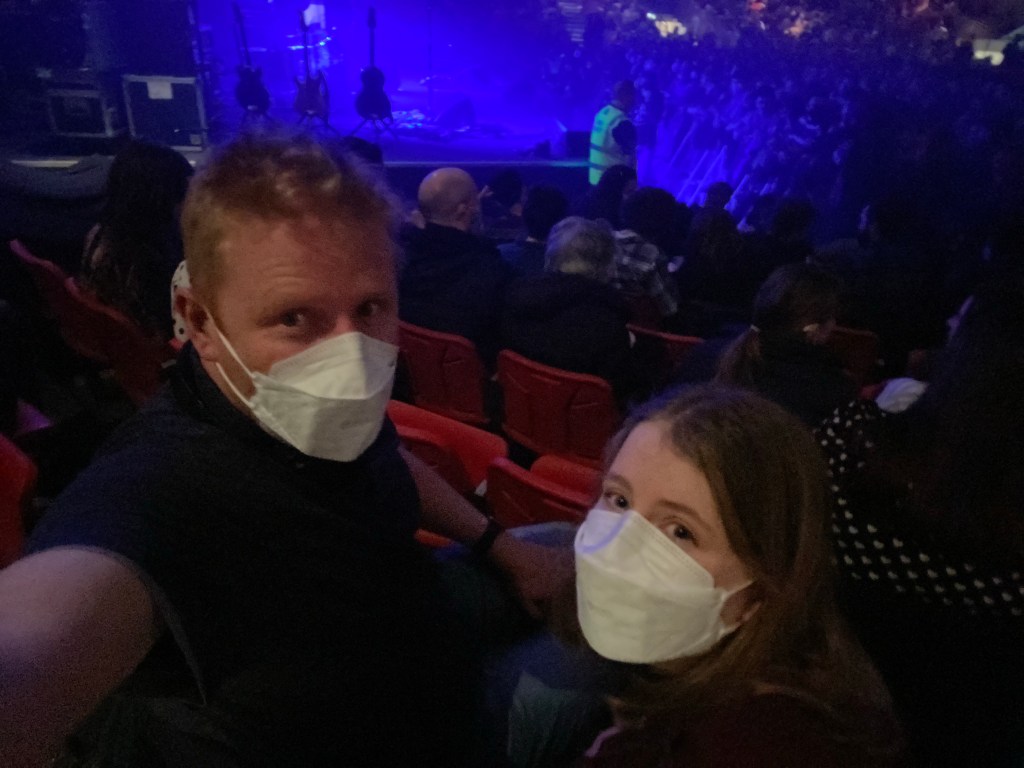
Over the coming weeks I get some lessons in listening fatigue and how bad the tinnitus can get. I go home each evening exhausted, sort out a few things for the kids, and go to sleep for a while. The tinnitus deserves a whole blog post to itself- Tinnitus Talk. Ultimately I know that I need time to adjust to the current situation and figure out the best way to get on with my life, dialing back the impact of my hearing loss. After a few weeks I talk to my incredibly supportive managers and we agree on a four day week. I drop meeting-lite Fridays. This becomes a day to refill the cup, learn to lipread, read about treatments and see if I can take a run at getting a cochlear implant. I joined a swimming group in the local baths. Cold Monday evenings of lane swimming and focus on drills and technique. This grows into a (near) daily (indoor) swimming habit. I bring my daughter to a Big Thief concert, relieved that an earplug means that I can stay and avoid the tinnitus becoming overwhelming. The sound isn’t quite what I’d choose, but the gig is amazing and I have a happy camper on my hands afterwards. I take Austin’s advice and I get out there and live.
 noisy silence