

It’s early November and I’ve left work for the final time for a while. I had spent a few weeks repeating my story and the plan at work. There was fantastic support and lots of well wishes. One or two people seemed a bit surprised or shocked. I think they misheard me saying “I’m getting a cochlear implant”, and were particularly taken aback when I said I’m taking a while off to learn how to use it.
I’m off for a couple of days of quality time with the kids before I head West to isolate before the surgery. I get great support from my colleagues and I’m able to work remotely up until the day before the trip. It is a pretty high stakes situation. There’s a chance that I get to Berlin and need to turn around and go back home if I have a positive COVID test. The COVID PCR could be positive for 2-3 weeks once you get an infection. This concentrates the mind.
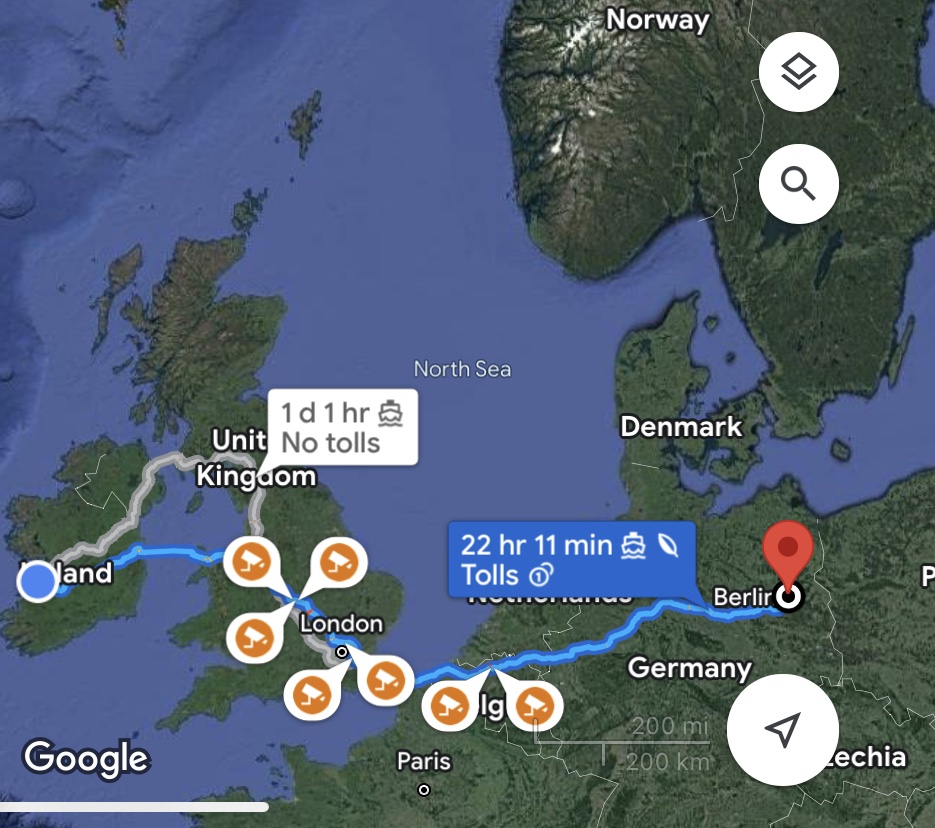
We spent time pouring over travel options. There were planned strikes and missed connections would have made it all very complicated and expensive. If everything went according to plan, our travel time would be 25 hours plus, before we broke it up with some hotel stays. Sticking Berlin into Google maps in the car gave a result of 22 hours. If I drove, I wouldn’t be sitting on a plane catching COVID on the way over. My wife could fly over at the time of the surgery and we could drive home together.
The night before I head West, there’s a sense of anxiety-tinged excitement. It’s a daunting undertaking, but we’ve got this far. The whole undertaking can be reduced to a long list of jobs to be ticked off one by one. Each a step closer to drawing a line under this chapter. Progress. We had a final family evening together on Nov 6th. We planned to get back from Berlin post-surgery on Dec 9th at around midnight. Before that, I’m isolating in Clare again. I will have a minder with me this time. A little furry constant companion.
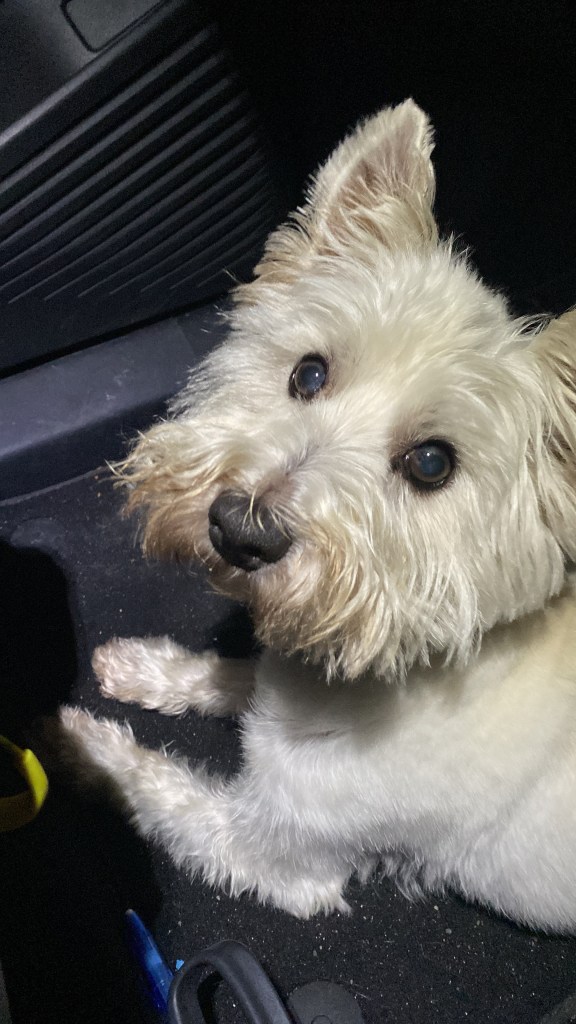
I worked through the tasks that I had saved up for when I was offsite and busy myself with work as I isolate. I try to get in the Atlantic as often as I can. I meet my family at the weekends for a masked, socially distant walk and burgers and chips in the rain in Athlone. They resupply me with groceries and then we tackle the next week.
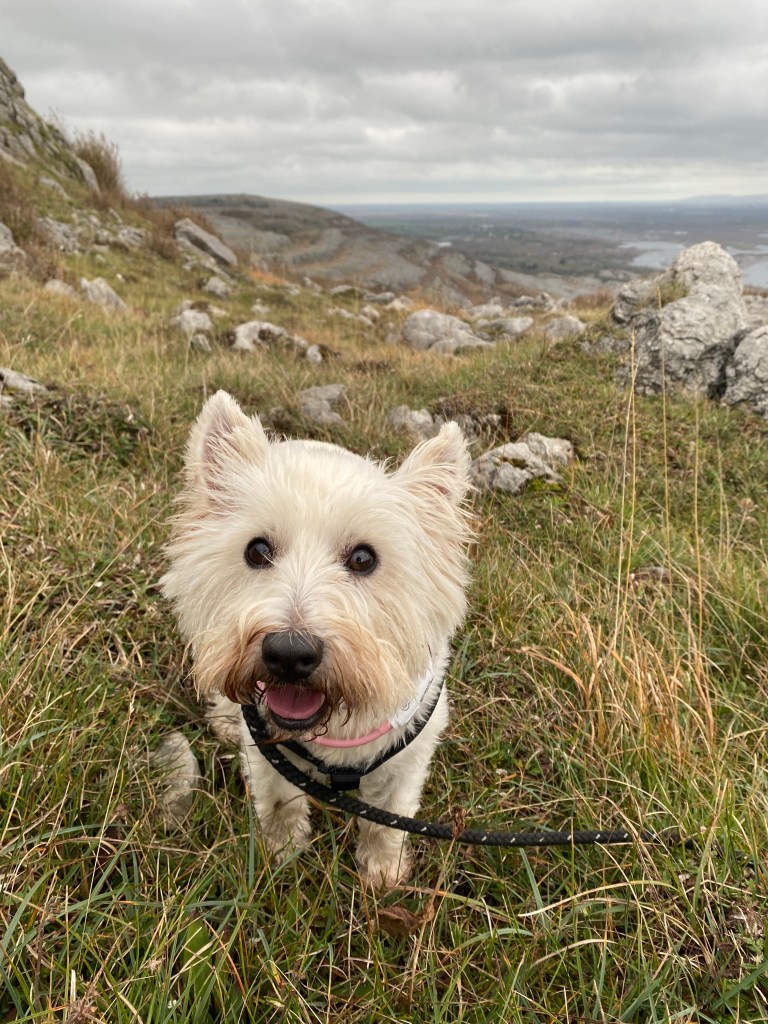
Me and the hound were on the side of a mountain listening to the Tinnitus Talk podcast and the guy who donated a million dollars to tinnitus research. People in my situation seem to be the lucky ones in terms of tinnitus- relief is possible with a cochlear implant. There’s an extensive discussion of the reasons why tinnitus gets so little attention. This blog is here to plot a course from severe tinnitus to relief. It’s great to hear that devices are under development that could effectively manage tinnitus. People with severe tinnitus distress have seen various hopeful management approaches fall as they went through the assessment process. Interventions that work are badly needed.
Every now and again I’ll stick on an old playlist. Like those people who get worse tinnitus with a glass of red wine; sometimes you accept that you’re going to pay the price.
I made it to the local swimming group two mornings the first week. The tinnitus takes a back seat when you’re swimming and bobbing and freezing in massive Atlantic waves. I find it hard to hear on land. I’m pretty much deaf at sea with ear plugs and two swim hats. I tried to stay on the periphery, I was there to isolate after all. I realised that being on the periphery intentionally is actually not that different to what happens naturally with hearing loss.
There’s an eLearning package about tinnitus that I tear straight into. It’s well put together, but there’s quite an emphasis on how the individual’s response to tinnitus and their degree of focus on it predict how severe it will be. I find this a little hard to take. I don’t think tinnitus is a single condition. The advice actually goes against some of my experience. I don’t have any functional hearing in my affected ear. I can’t mask the sound. Environmental sounds don’t make it better. They feed it. The tinnitus competes. Like an attention seeker, jumping up and down when there’s something else going on. I rarely put on music for my own enjoyment. When I do, the tinnitus always stays above the level of the music.
Me and my minder do lengths of the beach at Spanish Point. The tide has finally dropped at the time of our evening walk, clearing a path on the soft sand. We do 10 lengths. She runs in circles with her new LED collar blinking on the black beach. She doesn’t like the walk on the footpath up to the town. Cars cascade by and she alerts me before I hear the car with a tug on the lead and a pause/scared squat before we set off again. Solvitur ambulando. Again.
Doireann Ní Griofa’s A Ghost in the Throat accompanied me on many walks. I heard her talking about writing it on the radio. She sat parked on top of a multi storey car park with the car pointing at her heroine’s stomping ground. I’m parked with the car’s nose facing out to sea, tapping out this on my phone before another session of tramping up and down the beach. I pick two rocks and walked between them repeatedly, a kick punctuating each length of the beach. There’s a post-walk cup of tea at the car boot. We meet families of all shapes and sizes and I miss my own. At the car park there’s a family with four small boys and a big dog. Four small satellites orbiting their parents and full of the joys of life. I find myself pining for that bliss of ordinary life before the inevitable health challenges that we will all face.
A snippet of a David Attenborough documentary popped into my mind. It went viral around the time of the US election in 2016. My wife was in the US with work for the week and I was in that flying solo scenario that adds an anxious edge to the week and every task in it, a feeling that my wife has described this week. The morning after the election I was up early doing some work before the children woke. The usual distraction of Twitter threw up the video. A lizard is running through a desert being relentlessly chased by snakes. At one point they have him. He’s being squeezed by a knot of snakes in a death grip, but somehow struggles free and scrambles up a rocky incline with the snakes snapping at his feet. At the time I thought of Hilary and the possibility that she would have a similar lucky escape as the numbers were not looking good and the election had not yet been called. I have a good sense of why I’m thinking of it now.
It was my son’s 10th birthday party. My wife was at Bounce & Beyond with a gaggle of overexcited, sugar-filled little boys who were literally bouncing off the walls. There’s a lot of noise and screeching but I know I’d rather be there than here. He’s the youngest. I missed the last few days of single digits. The endless enthusiasm for Star Wars, Lego, the Farside, Nerf guns and Pokémon cards.
25/11/22
5 days before surgery
Departure day. 1957km to go. People pray and light candles for me. On whose intercession can I rely for hope? I run through the various to do lists and fill up the portable fridge in the car. Mini pizzas and lots of pasta. The key time for catching COVID now is during the trip at all the stops along the way, so I get a portable stove and have a practice run boiling water for a cup of tea in an enamel mug. There’s time for one last swim savouring the last of the Atlantic waves for a while and a farewell to all the regular swimmers.

The dog always knows that you’re getting ready for a trip and she’ll jump in the car at the earliest opportunity for fear of being left behind.
I stayed in Dublin the night before the ferry. Still isolating, we watch the Late Late Toy Show in separate rooms. This is a significant Irish institution and an important part of an Irish childhood. We sat separately in Christmas pyjamas watching the toy show and eating a Friday night take away.
26/11/22
4 days before surgery
There’s an early rise and a quick trip to Dublin port. After the little Clare to Dublin trip and the loss of my travelling companion, it was a daunting journey to set out on. The morning smells of the port, the sea breeze and bitumen, wash over me as I roll up to the ferry.
Night drive by Seamus Heaney is on Audible. “Your ordinariness was renewed there.” I’m running through lists in my head – it’s not the end of the world if I forget something, but it feels like it. It’s probably a manifestation of the stakes around dodging COVID on this trip. There’s a brief wobble where I’m about to be taken out of the queue as the port staff got a garbled message and they think I have COVID, rather than the intended message- please let me dodge crowds and get up on deck as soon as possible.
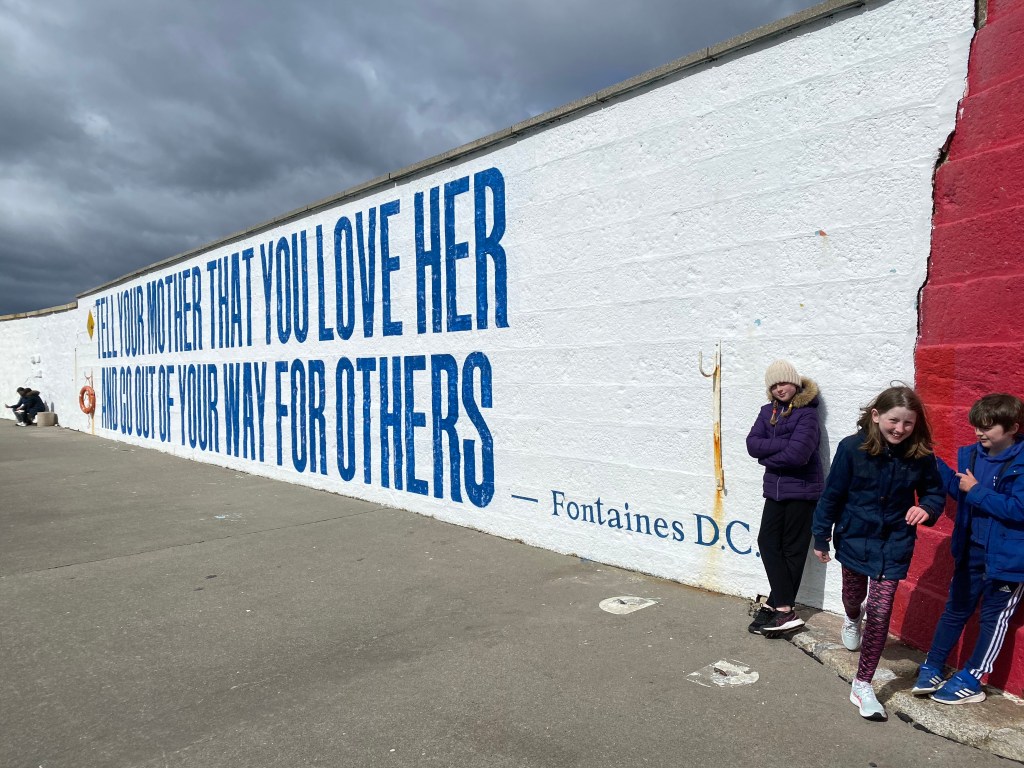
When I find an isolated spot on deck for the trip I remember all the walks on Clontarf seafront where I watched the ferries and imagined being on them for this trip- and here I am. As Dublin starts to shrink into the distance I see a hardy annual getting in for a swim at the Half Moon swim shelter. I’d love to be joining him. We go past the long sinewy south wall stretching out into Dublin Bay and the all-red lighthouse perched on the rocks at the end. I can’t see it from this side, but I know that on the other side of the wall bold lettering proclaims: “Tell your mother that you love her and go out of your way for others.”- Fontaines DC.
I walk the decks to get to the port side and see Dollymount Strand fading away. I put up a lot of miles on that beach. Trying to put distance between me and the hearing loss. Thankfully it’s easy to avoid people on deck as the Bailey lighthouse blinks and bids farewell.
On the crossing I seek the most sheltered aspect of the ferry. I have lots of layers on, but it’s still freezing. I walk up and down the deck, buffeted by the billowing wind. Joseph O’Connor’s Star of the Sea has helped pass the first two hours. For a break I move onto an old playlist from summers in France that provided the soundtrack for ferry crossings, long drives, fresh baguettes and croissants for breakfast and long evenings sitting out over dinner. I’ve (devastatingly) veered away from music this year. Not consciously. Just an aversion reaction. The tinnitus always rises to match or exceed the volume of whatever is playing. I have a Pavlovian response to this aversion therapy now. It’s still worth paying the price, but there’s definitely a rationing of music, consciously or unconsciously.
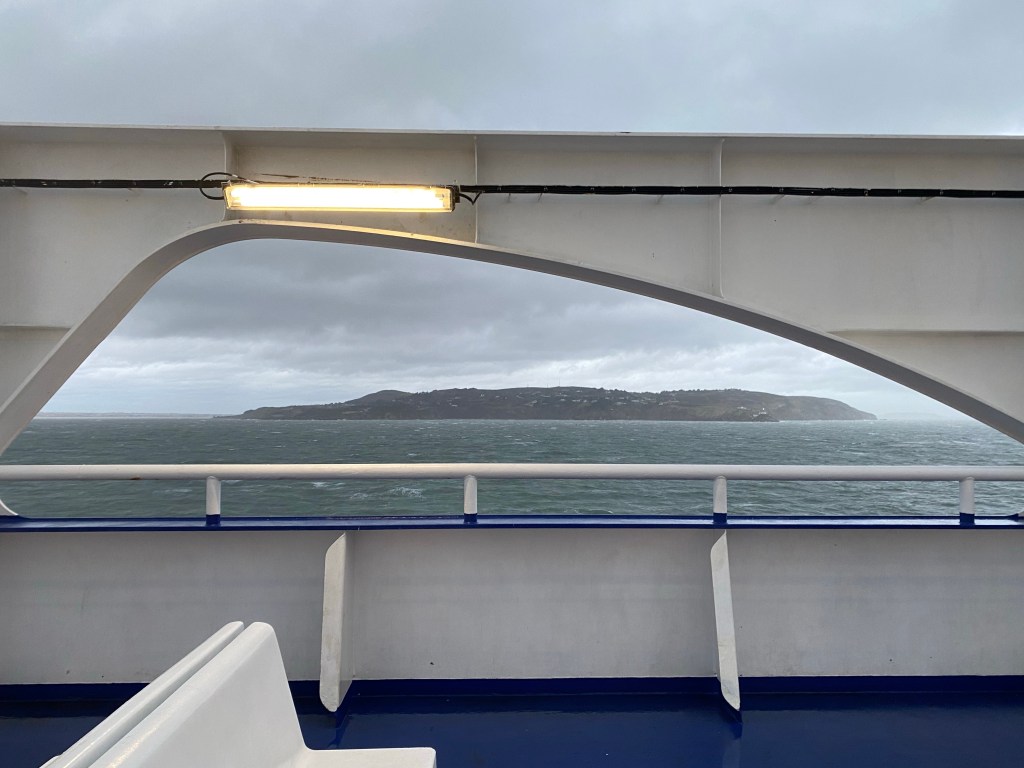
It’s an efficient trip across the UK and I hit all my charging points as planned. I need a recharge myself by the time the car needs a charge and make the first of many roadside cups of tea. I scope out the Eurotunnel for the morning and get an early night.
27/11/22
3 days before surgery
A shorter trip through consistent rain from Folkestone to Dortmund on day 2. At the hotel I keep going with my rewatch of the Sopranos- a comfort blanket far from home. The 3rd day will be an easier four or five hours.
28/11/22
2 days before surgery
I left my guesthouse near Dortmund early. It’s funny when you arrive someplace in the dark and don’t get a proper sense of it. I was well out in the countryside, driving past huge mounds of sugar beet like the ones I used to see at the side of the road as a small child before the sugar factory closed in Tuam. I passed a small field of dead sunflowers staring solemnly at the ground and rejoined the autobahn.
Lucy in the sky with diamonds comes on an old playlist. There’s music for small snippets of the journey. I think about some of the things I’ve read and heard about tinnitus. One of the things I came across as a treatment option was psilocybin, the naturally occurring psychedelic in magic mushrooms. The theory is that tinnitus becomes other, not part of you anymore and it is easier to ignore. This sounds like complete bullshit to me and the websites pushing psilocybin retreats are filled with pseudoscientific nonsense. Tinnitus seems to be getting pulled into the hype cycle around therapeutics with hallucinogens. The standard advice that I’ve come across so far is in the territory of “Ignore it and it will go away” or, “You’ll habituate eventually”. This doesn’t do much for someone in the midst of extreme tinnitus distress. It feels like the patient is being ignored, not the tinnitus and I understand why people will try anything. While I drive I think about opportunity cost. It is a little over 11 months since my hearing loss. If I didn’t have the scientific literacy and the training to find and appraise scientific information, I could have been sucked down dead ends that would have delayed definitive treatment. Someone googling “tinnitus cure” will get a first page of reputable sites, but it’s not long before they are bombarded with ads for supplements and all kinds of alternative treatments that will waste their time and money.
I thought about the Tinnitus Talk podcast mentioned earlier- the man who donated a million dollars to tinnitus research. He tried everything, up to and nearly including an Ayahuasca ceremony in South America. The most heartening part was the friendship that developed with a clinician scientist and their collaborative work on a surgical approach for patients with severe tinnitus who do not meet the criteria for a cochlear implant. This surgery places an implant at the entrance to the cochlea. After surgery electrical stimulation at the round window can alleviate severe tinnitus. Obviously this comes at a significant cost- the surgery, the implant, the aftercare. You need to understand, however, that severe tinnitus is a Sisyphean task that is lifelong. You may get used to pushing that stone up the hill, but you will forever remain pushing that stone. Personally, I would invest a lot of time and effort in getting away from this. If you are in a similar boat, avoid the quacks. Save your time, energy and resources for things that will help you.
I passed an overturned truck on the westbound side of the autobahn, with an incredible traffic jam stretching out behind it. A massive crane is parked in the middle of the motorway, trying to right the truck. I think about my own situation. I can’t help but feel that it’s kind of like what I’m trying to do at the moment. I look at all the traffic and think of all the things that have built up as a result of this current (hopefully temporary) impairment. I think of this massive undertaking in the same way that I think about big projects at work. Get one thing clear at the outset- what does good look like (start with the end in mind).
What does good look like? For me, I suppose it is some return to binaural hearing. Greatly diminished tinnitus while I wear the implant. Reversal of some of the things that tinnitus gradually strips away: being better able to hear my children and family, being less impacted by high noise levels, less fatigue, having to devote less effort to suppressing the inclination towards being a grouchy bastard. On the social front, I don’t want to say no to any social situation as a result of my hearing in the future. I don’t have unrealistic expectations of the new bionic me being an all-singing, all-dancing social animal that can hear perfectly in any situation, but I do hope that some of the things that I missed out on this year will be made good next year. I will engage with every social situation, I will actively seek out music sessions. I’ll play with local musicians that I was playing with before my hearing loss. I will actively spend more time with my extended family. There were significant periods over this process where I had to avoid people to ensure that I didn’t miss out on treatment or assessment or the extreme isolation required to ensure that I have a negative COVID PCR in a couple of days. This isolation doesn’t stop now- it will extend into the recovery period and Christmas so that there is no prospect of me missing the activation trip to Berlin with my family on January 1st. Ultimately the truck tailback was 20km long. This is what happens when you block a motorway with a crane. Likewise when you damage an essential sense like hearing, it’s hard to fathom all the downstream impacts- personal, familial, social, occupational, educational, financial and many others.
I thankfully arrive in Berlin in one piece. The worst part of the journey was accidentally throwing out 5 squares of Cadbury’s Wholenut while making a cup of tea at a truck stop- I think that’s a pretty good outcome. I do a quick reconnaissance mission after dropping my gear at the Air BnB so that there are no surprises tomorrow- the first of the dates on my admission papers for the hospital. I walked laps of the hospital campus finishing Joseph O’Connor’s Star of the Sea.
29/11/22
1 day before surgery
My pre-op appointment date has finally landed and it’s time for a COVID test (which is honestly the most daunting part of this whole experience) followed by some assessments and a meeting with the anaesthetist. I’ve avoided people for weeks- hopefully I got to the finish line intact.
I get through the check in process with the admin team – form filling- sign here, here, here. English copies too! Then a medical history with the nursing team followed by an assessment by the ENT resident. Then I go from the HNO (ENT) ward back down to Cochlear Implant outpatients where I was originally assessed for a brief test of my eardrum and a pre-op assessment by Narkosearzt or anaesthetist who has just come back from a trip to Ireland last month. Finally the wait to see the consultant who will perform the surgery. He’s friendly, around my age and looks like someone who I could have met at a Pearl Jam concert. I like him and trust him. He’s happy with all the work up so far. He quickly feels behind my ear and I pass the test. He puts a mark on the surgical site. A precaution against wrong site surgery. I think about the poor child who had a healthy kidney removed instead of a failing one and I’m grateful for learning health systems. I’m watching the clock. I’ll hopefully have time for a quick haircut (I’ve been isolating for weeks now and will probably need to dodge haircuts for a while after) before getting to the CI rehab centre for an introductory meeting at 3.
Through my poor German and inability to clearly get a message through a couple of steps of translation from English to German to Turkish, I end up with a skin fade. The barber holds up a mirror to show me the crazy mark behind my ear. Do I want it cleaned off? I really feel the haircut as it’s freezing cold in Berlin, but at least I’ve saved them some shaving around the surgery site tomorrow.
I had an excellent first appointment with the Speech Therapist who will be helping me with auditory rehabilitation after I’m activated on January 3rd. She’s incredibly reassuring and sets out the process for me. I get to see the Kanso 2 and Nucleus 8 devices that I will choose from. The first is an off the ear processor. No wires involved. The second is a behind the ear processor that has a wire that connects the microphone/battery processor element sitting behind te ear to the coil/magnet that sticks onto the internal implant.
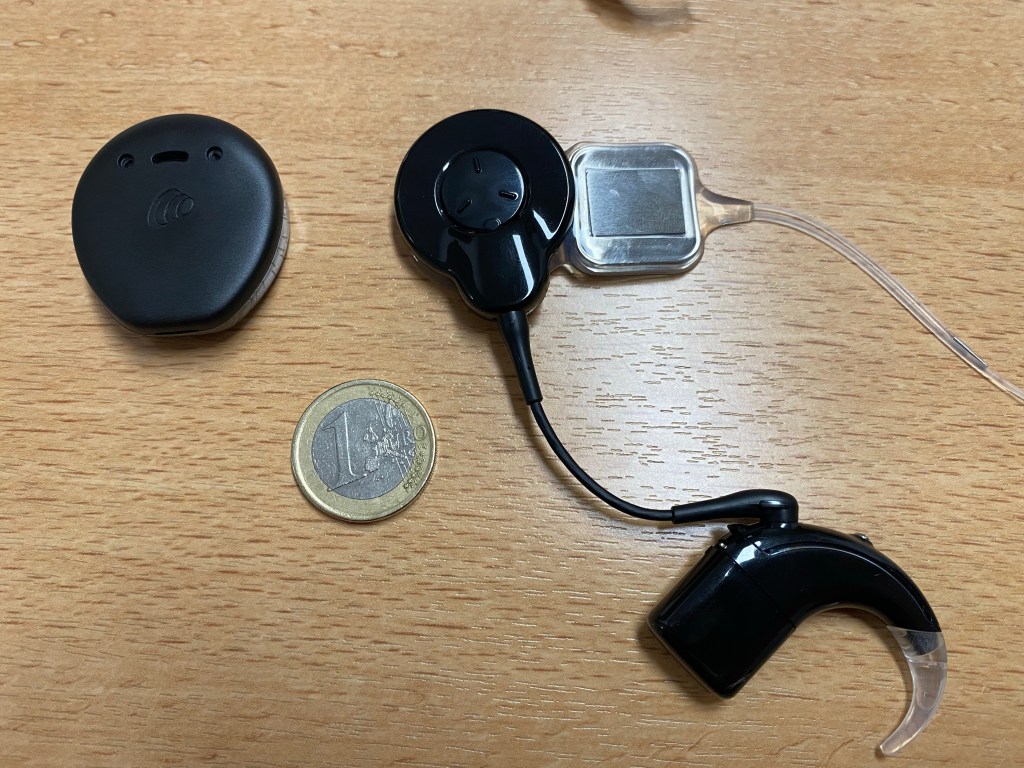
Then it’s the final countdown. I was looking forward to eating something other than pizza or pasta. The small pizzas that I made in Clare before I left and the car fridge box have served me well, but I’m looking forward to hot food again. I eat in an amazing Turkish restaurant near the hospital in an area that has housed the Gastarbeiter (international workers) who helped to rebuild Germany and drive the post-war economic miracle. I totally over-order and leave stuffed and have no trouble sleeping before the big day tomorrow.
30/11/22
Surgery day
I sat in the foyer of the specialist surgery clinic at the Rudolph Virchow Campus of Charité. Half an hour early, watching the various staff members arriving from 6:15. It’s time to go up and check in. The trip is complete. There’s still a niggle that someone will tell me that my COVID test was positive.

 noisy silence