

21/02/23
I’m sitting in the Tuam Library reading in a comfy chair in good light.
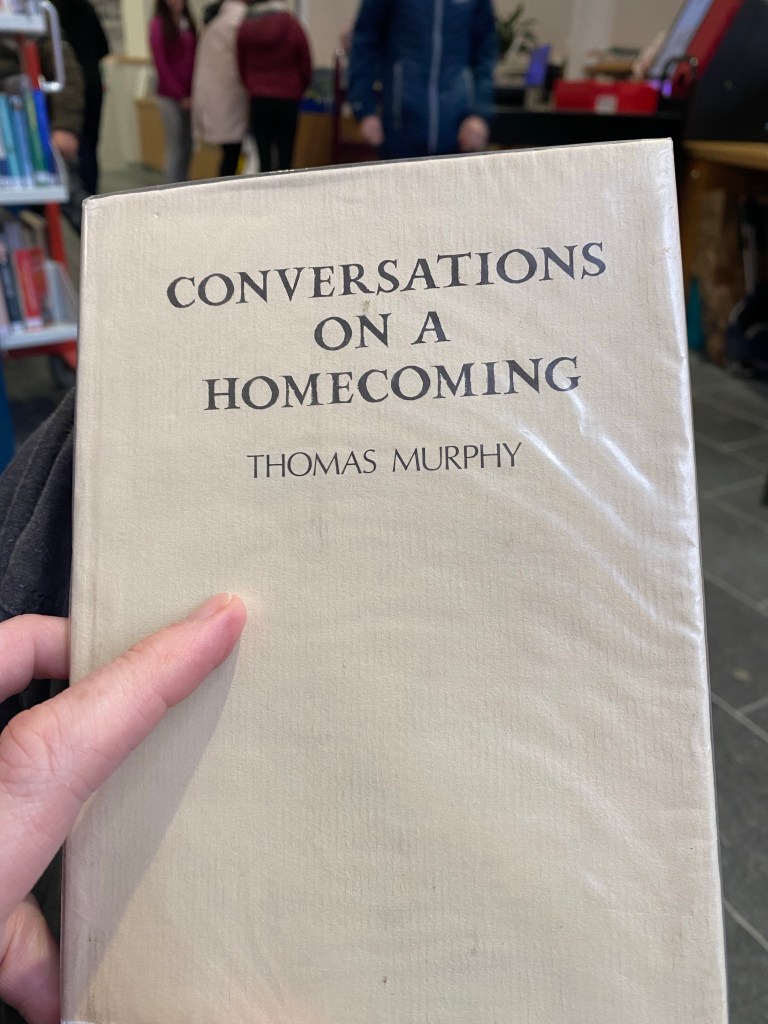
Time and place: The early 1970s. A pub in a town in east Galway.
How can you fault a play that has the opening line: “Well bollix!”?
I love libraries. I seek out hard copies of whatever book I’m streaming to the CI and follow along if needed, so I’ve been spending more time in libraries than usual. Streamed audiobooks sound great. The voice does not have the full pitch range and timbre of what I hear in my good ear, but the pitch of the voice has dropped from chipmunk territory recently. I get the vast majority of words and I need to go to the hard copy book for missed words less and less.
Streaming audiobooks was fine for me for the initial listening experience. It helped me isolate the CI from other sound input via my good ear. You are listening to an actor with a pretty expensive studio mic under the supervision of a sound engineer. Unfortunately, life does not always deliver this kind of audio fidelity and I need to practise “messier” listening too. An example is regular talk radio- the host sounds great, but any contributors on a phone line are more of a challenge. Phone calls are also beyond me at the moment. If I put the phone to my CI I can hear the speaker, but my word recognition is poor for now. Over the past few days, the wake and pub conversations afterwards gave me some new listening challenges. I think I need to put myself out there more and set about organising meetups with friends over the coming days to add to the variety of auditory stimulation.
22/02/23
I read about long-term CI experience on one of the Facebook CI groups. If you are a member, you can read it here.
If not, a 31-year CI veteran outlines what she can hear, going from the easiest things to the most challenging. She starts with environmental sounds such as the ticking of a clock, running water, sizzling bacon, rustling leaves, footsteps, children playing, birds singing and rainfall. Next is direct streaming to the CI, followed by outdoor sounds and conversations, then quiet indoor locations with 4 or fewer people. Finally, she outlines the most challenging situations: large groups in noisy environments and then communicating with people with strong accents or very young children. I wonder how accessible noisy environments will be while sitting in a noisy cafe. I feel that I’ll definitely need to explore remote mics and the best programmes on the CI to push the boundaries of where I can hear well.
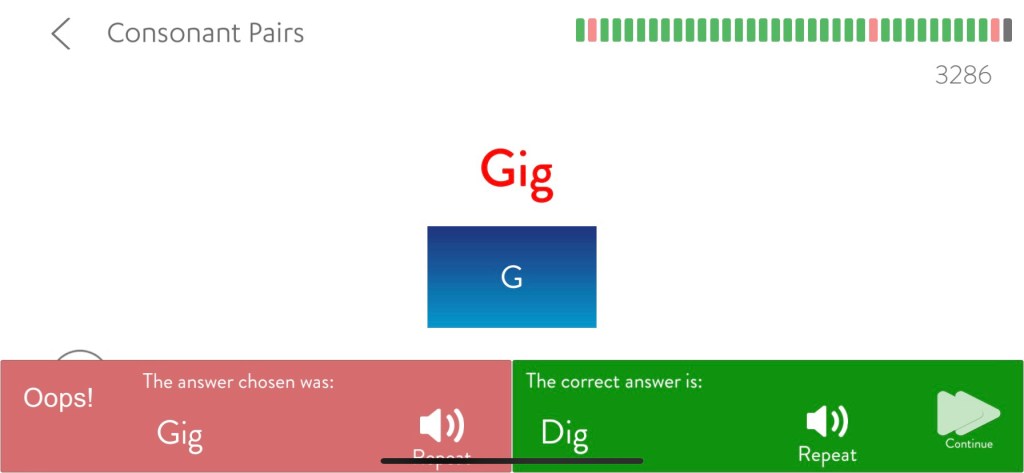
I start to pay attention to spatial audio: the cars passing me when I’m out for a walk, birds flying around me and people calling me from different rooms in the house. I try to think of other ways to practice spatial hearing- the children hiding my phone then ringing it for me to find and shaking an enamel mug with rice in it and picking out where the sound is (at six o’clock or nine o’clock relative to the direction I’m facing while blindfolded). It’s great to read that the BEARS study is using virtual reality to develop spatial listening skills for bilaterally implanted children. There will be important outputs from this work. I hope it helps lead to accessible spatial audio training resources for all CI recipients.
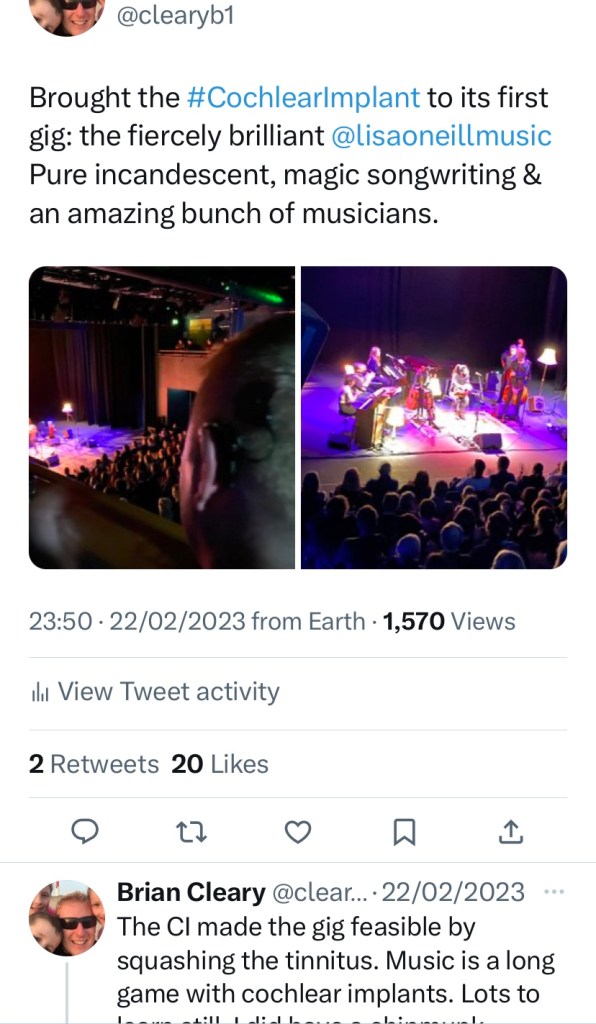
Went to the first gig with the CI. The tinnitus has been defeated! It’ll take a lot of work to improve my stereo music experience though.
27/02/23
I wake and do my Hearoes exercises first thing. Musical instruments are so tough, I find it difficult to even think of how I could simulate the sound. I try to describe each instrument in turn, but they all essentially sound like badly built bells being clattered with mallets. Some instruments have clear indicators that identify them- drums, the plucking of harp strings, the percussive aspects of the xylophone. Pitch differentiation is very tricky right now- hopefully that’ll come in time.
04/03/23
Another forest walk. I pay close attention to the direction of the birds and feel that I might be making some progress. Afterwards, I ordered maracas to make spatial training at home a little easier. The kids are happy to help. I develop a simple Google form that presents each hour of the clock in random order. I sit blindfolded and the kids go the required locations around me (about 1m from my head) and shake both maracas. I get a point if I get the correct location plus or minus one hour. The forms will all feed a big spreadsheet that will grow in time and allow me to track progress.
I also put some time into pitch training, although my primary focus is on speech for now. In this training, I can’t distinguish middle C from C6, an octave up. With harsh electronic notes a long way apart, I have some ability to distinguish them. I use the Bring Back the Beat app to do simple exercises distinguishing two notes and move on slowly. I run into some issues with the app where it won’t reliably stream audio to the CI. It seems to work if I play music in the background, but this makes the exercises a little more challenging than necessary. I finally come up with the idea of playing John Cage’s 4’33” on loop and it solves the problem.

05/03/23
We go to a literary lunch with Donal Ryan as part of the Ennis Book Club Festival. This is part of getting out there and practising in complex listening environments. It’s a fantastic event and I can hear clearly in a pretty loud, crowded setting, thanks to a good sound engineer. Afterwards, as we got off the motorway and into city traffic on the drive back to Dublin, I felt the grim spectre of tinnitus returning. It seemed reactive to some sounds – radio on my left, the sound of certain packaging and the sound of Hearoes exercises. It was certainly disheartening, but I put it down to the overstimulation of a lot of driving/road noise combined with the sound environment of the literary lunch. Using my normal map for long journeys exposes me to a lot of low-frequency rumbling road noise. I can remove this by using one of my scan programmes that filter out background noise.
There were a variety of great talks at the Ennis Book Club Festival over the weekend. One of the quotes that stuck with me was from a talk by Colm Liddy, a fellow Pharmacist and history nut, about Nan Hogan, a local leader of Cumann na mBan (paramilitary organisation for women who were active during the Irish War of Independence and Civil War). He described a scene from the Easter Rising where a group of Volunteers spent two days in the rain acting on orders to cut roads from Clare to Limerick, their leader, Michael Brennan, noted that lots of men were willing to die for Ireland, but that few were willing to get wet doing so.
10/03/23
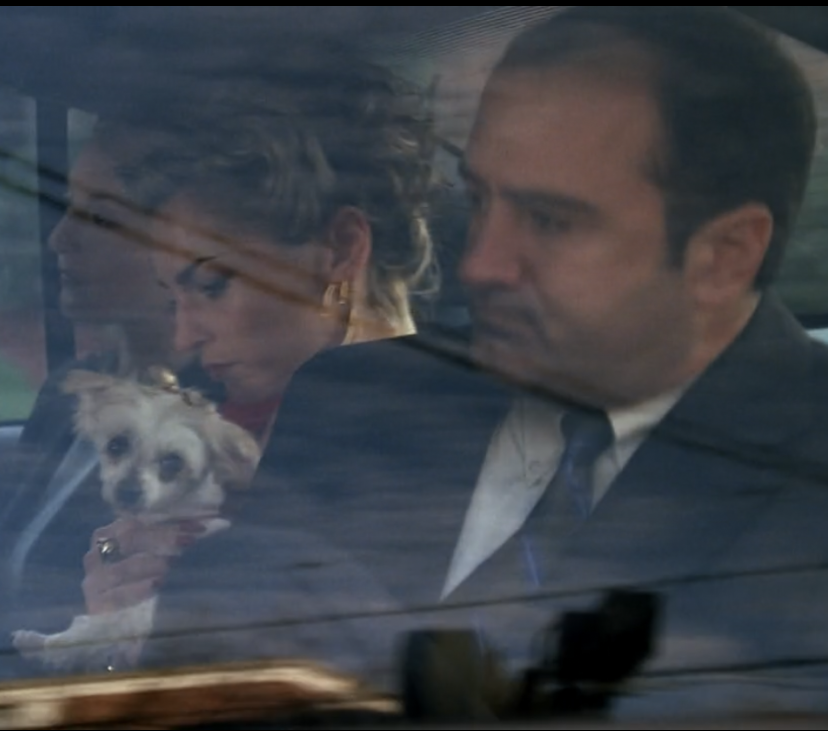
Back to Berlin for a mapping and a weekend with my Dad. I sit at the gate and stream The Sopranos. I still need the subtitles to catch some words. It’s the saddest part of the rehab process so far. IYKYK 😭😭😭
I need to order my device today. I’m retiring the Kanso 2 and ordering a Nucleus 8. I’d love to have a Kanso, but I can envisage a situation where I’m really stuck because it comes off. I won’t wear a tether forever and although it sticks well, you can’t predict what you or someone else might do to inadvertently knock it off.
We go through the mapping process, sequentially working through the frequencies (22 electrodes) to fix a comfortable sound volume. This is the first time I’m coming away with a map that is quieter than the previous one. We really took down some of the higher-frequency electrodes that were sounding a lot louder than the others.
11/03/23
Three months on and I’m back in the Tap Room again. This is the pub owned by a small independent brewery. The beer never disappoints in Berlin. Hearing with the CI in this kind of environment is not straightforward, but it is feasible. I need to adjust the map in the pub to use a Scan programme that includes additional features, removing background noise and helping me to focus on speech. I can also use Forward Focus to cut out sound around me and focus the microphone beam on the person that I’m talking to. The ever-considerate Germans have installed lots of acoustic panels on the ceiling. The tinnitus stays under control and the music is totally manageable.

13/03/23
I’m happy with my level of word recognition when I’m streaming, but feel I need further work in real-world conditions. I try using a silicone earplug in my good ear to make the CI do more heavy lifting (didn’t last).
19/03/23
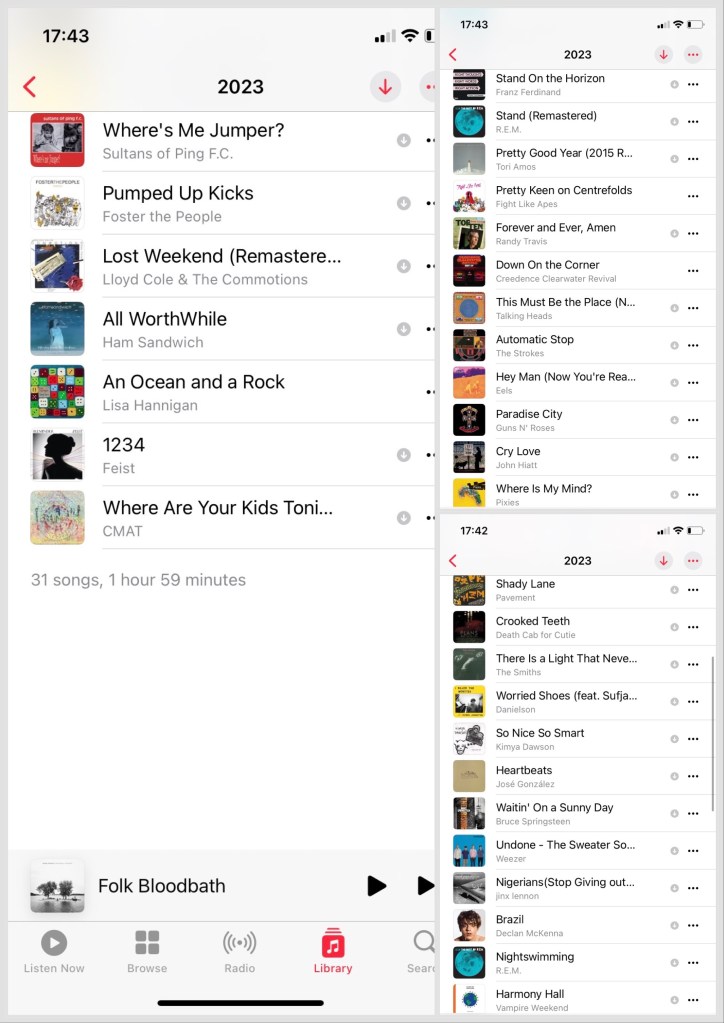
I put on background music with dinner for the first time in ages. It’s feasible without wiping out all my understanding of the dinner table conversation. It’s time to start building a 2023 playlist. Music had unfortunately slowly disappeared from the house over the past year or so. Music is sounding better now- it doesn’t need to compete with (and always lose to) the tinnitus. I can hear some elements of the song fine in stereo (snare drum, hi-hats, cymbals, solo voices), but a non-distorted and totally coherent, stereo version of the songs that I know well remains elusive. As for new songs, I have never heard them in stereo, so I really have nothing to compare to.
22/03/23
Sopranos streaming again. Without subtitles, I’m missing elements- there are background noises (bars, cars, chatter and everyday din) and the sound mix is very different to an audiobook. More work is needed. I veer towards louder maps for better word recognition. Moving to the quieter map in response to sound sensitivity and tinnitus a few weeks back comes at the cost of reduced word recognition.
25/03/23
We went to a local theatre for the children’s traditional Irish music concert (Ceoltóirí Clontarf). While the players were all technically proficient and gave it their all, to me it sounded like someone doing mean things to cats. A few things became apparent. I need to learn to hear music again- while word recognition came to me quite easily, music does not. I need to be realistic about what two tiny microphones attached to the side of my head can achieve when I’m in a setting like a theatre- I may need help from either additional microphones or a means of tapping into the venue’s audio system. Finally, I need to set realistic expectations. Squeezing the full sonic range from tin whistles to massive Celtic harps through 22 electrodes is a big ask. These 22 electrodes are trying to replace about three thousand five hundred inner hair cells and their associated neural connections to the areas of my brain responsible for hearing and music appreciation. Maybe it’s possible in time? Maybe I need to accept a lo-fi version of music for the time being? I definitely need to be positive and take hope from stories of people who worked at music and got great results.
01/04/23
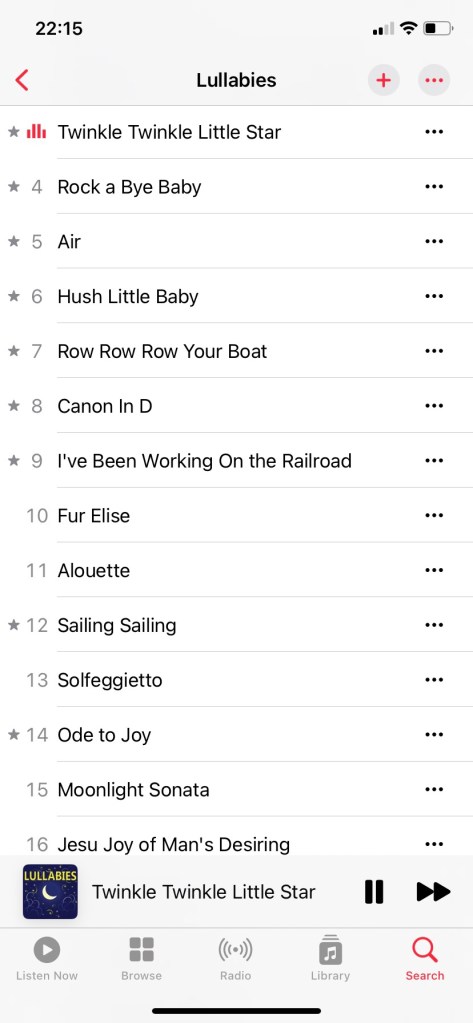
At the concert last week the only song I could really “appreciate” in stereo was Twinkle Twinkle Little Star. The little people playing this played a very simple and easy-to-recognise song in unison. The more complex pieces were sonic mush. I need more of the former, so I began working through a lullabies album to learn to differentiate pitch and to gradually improve what I can discern with music.
Listening in a silent room I think I have an inkling of what babies experience as they start to piece together the world around them through their senses. I feel the need to go back to basics with music. In preparing for the rehabilitation process, I read about people who went back to very basic English books- children’s stories and English as a foreign language books. I seem to have been able to skip this with audiobooks, but I need to go right back to the fundamentals of music and the musicality of speech. My therapist in the CI centre is treating me as a child (in a good way) i.e. they feel that there is significant neuroplasticity potential that will let me get the most out of the implant and that I shouldn’t routinely need to use built-in filters to hear well. Guiding principles for paediatric CI habilitation are useful and the one recommending making music part of the rehab process resonates with me.
20/04/23
#NH Listening to an album of lullabies streaming to my CI. Sounds like a Glockenspiel and I can pick out the tune of I’ve Been Working on the Railroad, Ode to Joy and Alouette. I cannot make out Für Elise.
25/04/23
#NH The trumpet solo in Sufjan Steven’s Chicago punches through the general cacophony of what I hear on the left listening through speakers. It is a modified version of what I hear on the right, but it’s definitely a trumpet, and I can distinguish the notes easily. This is a baby step, but it is a long way from the initial experience with instruments where I couldn’t distinguish one from another or tell notes apart in the early exercises.
What does a CI sound like? There are simulators, but they don’t quite match what I hear. I’ll try to work with a sound engineer at some point to get some clear samples of what I hear.
28/04/23
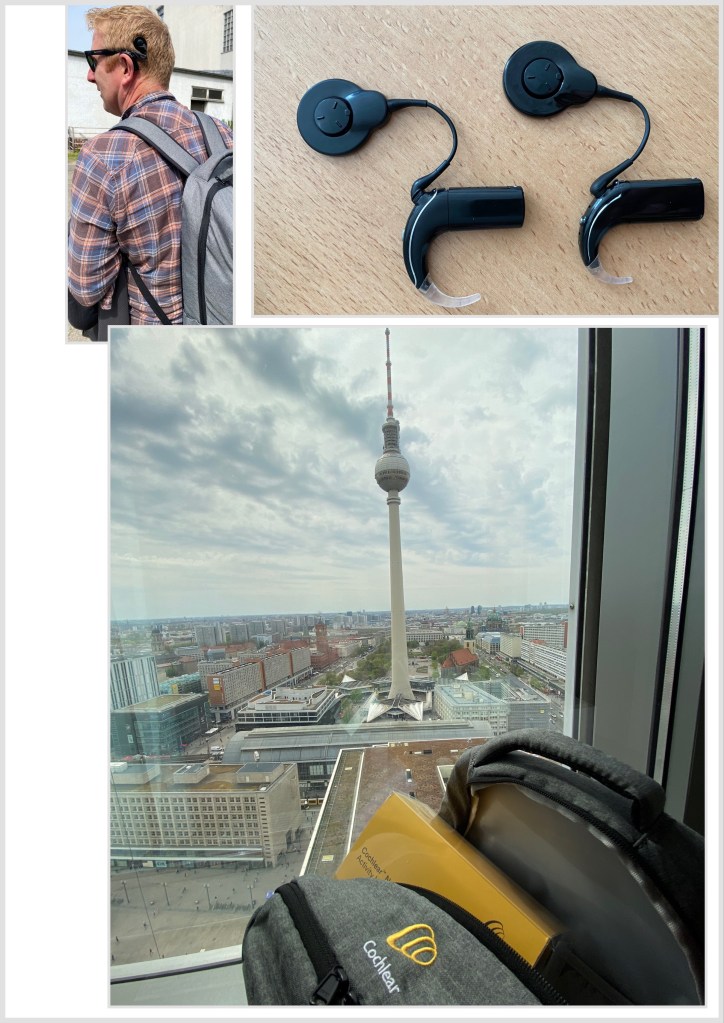
Back at the boarding gate on the way to Berlin again. It’s the first mapping session in a while (one got cancelled due to illness). I leave with a Cochlear bag of goodies and my new Nucleus 8. My wife comes with me for this trip. There are sniggers as we are told about the Mini Mic2+ or Mini Mick as it is referred to. Putting it on the table in social situations will greatly improve my hearing. There’s more sniggering when we discuss using the Roger On remote microphone.
We really squeezed the most out of the day by going to a late Jose Gonzalez gig and film at the Babylon Cinema (always check the gig guide before you travel!) In this incredible setting of an intact 1920s cinema, with the original organ and an in-house organist, we got to see the incredible film “A Tiger in Paradise”, followed by an interview and six or seven songs. It sounded great with my new map.

Back to the hotel room after a very long day, I listened to Hold On by Alabama Shakes.There was a beautiful centred feeling for the drums and guitar intro. The singing was recognisable in terms of lyrics, voice timbre, and pitch. A little distorted on the left, but not bad. I could hear the summative effect of improving binaural hearing giving me a much more balanced and louder listening experience overall.
01/05/23
I get to practise a little self-advocacy, getting the Berlin Unterwelten (highly recommended) tour guide to wear the Minimic during a tour of the tunnels under the Berlin Wall. This was my first experience of a remote mic and it gave me clear, crisp sound, ensuring that I didn’t miss a word, even when I couldn’t get near the tour guide. My Dad did the same tour on a previous trip and unfortunately missed out on a lot of the detail of the tour due to his noise-related hearing loss.
I left Berlin after a great weekend with new jeans & shoes, a slight colour from the late spring sunshine, and, most importantly, a warm glow due to better hearing. It is a strange phenomenon to go away for the weekend and come back with better hearing.
04/05/23
May the fourth. My son is paying tribute to Star Wars on the piano. He slides into the bass line of Seven Nation Army and I can hear the distinct notes, it sounds like a lo-fi piano now as opposed to someone clattering a not so sonorous bell. It doesn’t have the full resonance that I have on the right, it’s constrained in a few ways that I find hard to describe, but at this volume and for these notes, I can hear them as music. There’s a caveat with everything. You can’t extrapolate this to all music and settings, but it’s pretty incredible to hear some aspects of music becoming clearer as they just click into place.
#NH R2D2 sounded pretty clear in The Empire Strikes Back this evening.
07/05/23
International Dawn Chorus Day and I’m up at 4am as I feel obliged to appreciate my new hearing. No one else in the house is as enthusiastic.

The Park Ranger guided this assorted crew of early risers into a pitch black St Anne’s Park, former home of the Guinness heirs. We heard the gradual awakening of robins, blackbirds, herring gulls, wood pigeon, daws, herons, goldcrests, crows, little egrets, tufted doves, great tits (teacher, teacher), wrens (machine gun-like trill) and the frantic fluttering of common pippistrelle bats finishing up their nights’ hunting over a man-made lake. I could imagine the Guinnesses enjoying this place 150 years ago, entertaining guests at a folly by the lake. The sun rose slowly over the sea. We heard the prehistoric sounds of the heronry- a drunken guttural gurgling sound of plop, plop, put, put, put. The guide taught us how to identify different types of birdsong: chaffinches had a descending song with a trill at the end; bluetits sounded like someone trying to start a car engine that keeps cutting out; wrens sang so fast that you had to slow down the audio to pick out individual notes; jackdaws go Jack, Jack, Jack, Jack; and dunnocks, anonymous looking little brown yokes, sound like squeaky wheels.

It was magical appreciating the dawn chorus in stereo. It was also in my comfort zone from a frequency perspective. It was a delight to be awash with new and never-noticed sounds.
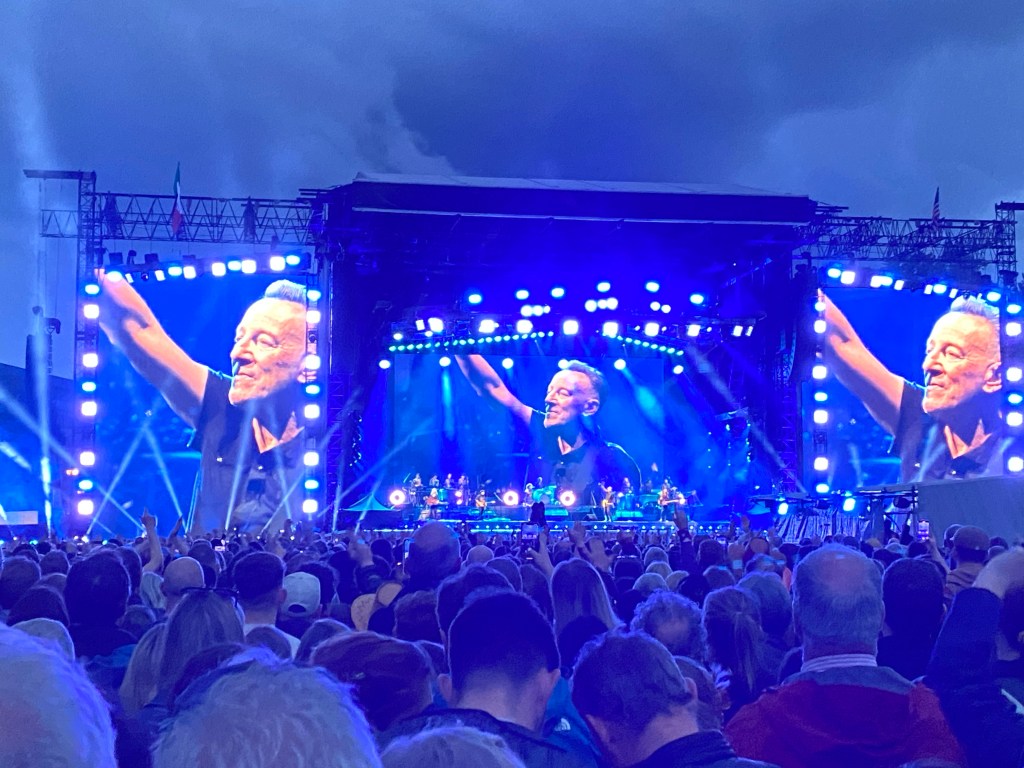
That night it was time for Bruce Springsteen and the E-Street Band. I played around with my maps and settings and ended up using my scan program with the original Charite (loudest) map. It was a pleasant surprise and much better than sitting at home on the couch. If I was Deaf, I’d be here to feel the thud of the bass drum in my chest. I didn’t get the sport gene. Music is my thing and it would be devastating not to be able to listen to it or go to gigs. The experience of gigs with single sided deafness and severe tinnitus last year was slightly better than being at home, but it was a tinnitus-tinged experience.
Some elements of the sound fare better than others. As my good ear has a musician’s ear plug in it, I get a reasonably balanced sound even though a lot of the left is distorted. With the sound of the crowd and the outdoor sound, my experience of the gig was not a million miles from what I would have experienced without hearing loss. Max Weinberg’s drums beat a path into the middle of my head. Jake Clemens’ sax solos also pass through unhindered, as do most of the brass section. Some of the higher guitar solos and elements of the piano work well too. I leave elated. As usual for Bruce & co, it is a life-affirming experience as they hammer through a spectacular set list. I feel that the extra volume input has beaten my tinnitus into submission. There’s a kick up the arse from the gig to get up and go. Get through the wall. Attack the rehab exercises with gusto again and make the most of every day.
What does it sound like? It sounds great.
 noisy silence